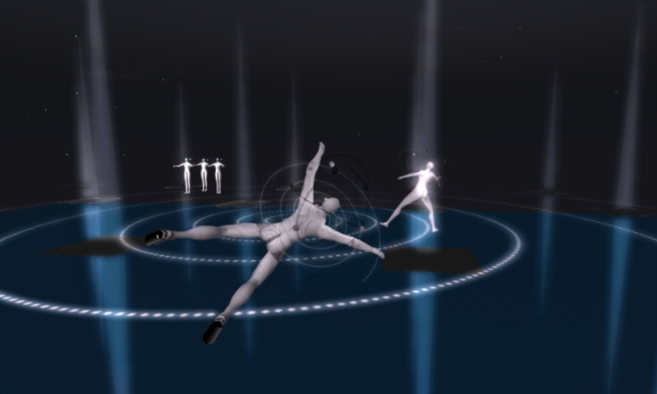
"Topophonia: Four Realizations in Sound"
Artist Statement
The principal conceit of "Topophonia" is the notion of bringing together a group of artists' to create artworks around a common concept. I have participated in several projects loosely modeled after the Surrealist "Exquisite Corpse" idea where multiple artists gather together and, over time, collaboratively create a single (usually messy!) piece of art. In my experience, the more detailed the explanation, the more rule-bound the process, the less successful the outcome. (Success, here, meaning my subjective evaluation of the resulting art.)
"Topophonia" is not, however, an "Exquisite Corpse" project. I was less interested in any sort of collaboration than in seeing how (or whether) other artists could understand and work from an artistic framework that I
personally found interesting in creating a new piece. And then, if that first step was possible, whether their resulting artworks in any way mirrored or complemented my own. So not a collaboration; rather, an experiment to test whether an artistic
idea is share-able, and to see the result of each artist independently operating on that idea in his or her unique fashion.
The concept was simple (or so I thought): create an installation in which a visitor progresses from the beginning toward a goal using
sound only to guide them, avoiding the use of visual clues. The idea is, in a sense, anti-curatorial. A curator starts with a concept and assembles an exhibition of artworks that support the concept. This process also starts with the concept, but assembles artists to create works to illuminate the concept from multiple perspectives, not knowing in advance what those works would be.
It turned out to be extremely difficult to effectively explain the concept to the artists! I selected the three participating artists for their effective use of sound in their Second Life artworks, thinking that at least they all understood how sound is used in an installation setting. But, as it turned out, the idea of using sound as the
primary artistic medium and using it to
guide visitors through their installations was a foreign notion.
My own piece ("Nine Rooms") turned out to be a variant of a maze of nine rooms. Each room has two doors: one leading forward to the next room, one sending the visitor back to the beginning. Each door emits a sound, and those sound cues are the only means by which the visitor can determine which door to open. There is plenty to look at on the way through, but nothing visual can be used to determine the best path through the maze.
However, I didn't want to use a maze metaphor to explain the concept to the artists, simply because I didn't want to end up with four variations on mazes. So I tried to use words like "guide", "sound cues", "goal". And then, wanting to avoid hard-and-fast rules, I also wanted to leave considerable space for the artists to consider their own interpretations of what I was trying to convey.
The results are, for me, very exciting. You see four entirely different works, all rich with sound, and yet all completely different in their approach to the initial concept. As an experiment, I suppose this result shouldn't be surprising at all. Artists will, after all, generally find their own path toward the goal. And thank goodness for that!
I want to thank HUMlab and Umea University for offering me the Yoshikaze "Up in the Air" residency, and to Sachiko Hayashi for her patience and assistance during these past few months. I am tremendously grateful to Alpha, Eupalinos, and Maya for agreeing to participate in this adventure, and for their good cheer and hard work over these few months.